
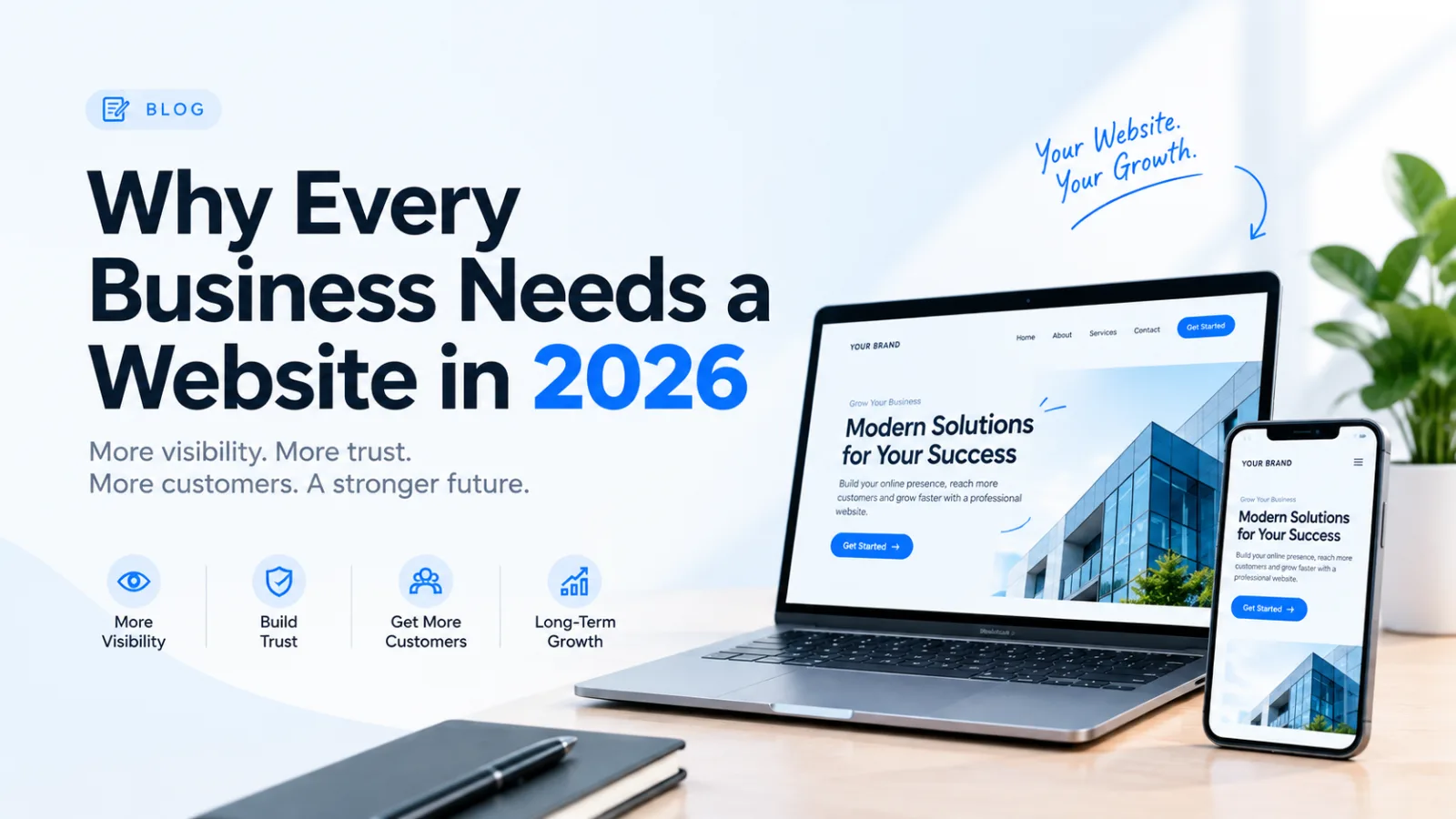
Why Every Business Needs a Website in 2026
A practical, human guide to why a modern business website still matters in 2026 — from Google Search and AI discovery to trust, leads, sales, bookings, customer experience and long-term business growth.
Founder & Principal Technologist
Imagine a potential customer hears about your business today. They do what almost everyone does: they search for you. They want to see what you offer, whether you look trustworthy, where you are, what other customers say, how to contact you and whether you can actually solve their problem.
If they find a useful, fast and professional website, you have a chance to turn that curiosity into a conversation, booking, enquiry or sale. If they find nothing, an outdated page or only a social media profile with limited information, they may simply move on.
That is why, in 2026, a business website is not just an online brochure. It is part of your sales system, credibility, customer experience, search visibility and digital infrastructure.
And the interesting part is that the website is becoming even more important as search changes. Customers are discovering businesses through traditional search, maps, social platforms, AI-powered search experiences, recommendations and increasingly conversational queries. Google itself continues to emphasize useful, original content and says existing SEO best practices remain relevant for its generative AI search experiences. Google Search Central: latest Search guidance
What Has Changed for Businesses in 2026?
Having a website used to mean putting your company name, address and phone number online. That is no longer enough.
A modern business website needs to help customers discover, understand, trust, compare and act.
Customers may arrive from Google Search, Google Maps, Instagram, Facebook, LinkedIn, YouTube, an email, a referral, an AI search result or a direct recommendation. Your website is where you can bring those different journeys together.
At the same time, AI-generated answers are changing how people research. Someone might ask an AI system, “What is the best website design company for a small business in Europe?” or “What should I look for when choosing a dental clinic?” Businesses cannot control whether an AI system mentions them, but they can make their public information clearer, more trustworthy, consistent and useful.
1. Your Website Is Your Digital Home
Social media is valuable, but it is still a platform that belongs to someone else.
Your website gives you a place where you control the structure, content, customer journey, branding and calls to action. You decide which services deserve attention, which products are highlighted and what happens when someone wants to contact you.
Think about it this way:
- Social media: great for discovery, conversations and attention.
- Search: great for capturing existing demand.
- Advertising: great for creating targeted demand quickly.
- Email: great for retention and repeat communication.
- Your website: the central place where these channels can lead customers toward a business outcome.
You do not have to choose between them. The strongest digital strategy connects them.
2. Customers Expect to Find You Online
Not every customer will search for your company by name. Many search for the problem they have.
A restaurant might be discovered through “Italian restaurant near me”. A dentist might be found through “emergency dentist” or a treatment search. A cleaning company might be discovered through “office cleaning service”. A construction company may be found through a project-specific search.
Your website gives you pages that can answer those searches directly.
That is one of the biggest differences between simply being online and having a real digital acquisition system.
3. A Website Builds Trust Before the First Conversation
People rarely arrive on a new business website completely convinced. They are evaluating you.
They may be asking themselves:
- Is this company legitimate?
- Do they actually provide the service I need?
- Have they worked with customers like me?
- Where are they based?
- What does the process look like?
- Can I contact a real person?
- What happens after I submit an enquiry?
A good website answers these questions naturally through service pages, team information, reviews, case studies, photographs, clear contact details, policies, FAQs and useful explanations.
Good design helps, but good information builds the deeper trust.
4. Your Website Can Generate Leads While You Sleep
A salesperson can only speak to one person at a time. A website can serve hundreds or thousands of people simultaneously.
For a service business, that could mean:
- Quote request forms
- Consultation bookings
- Appointment requests
- Phone and WhatsApp actions
- Downloadable guides
- Newsletter subscriptions
- Live chat or AI-assisted support
For ecommerce, the journey can go all the way from discovery to payment without a member of staff manually processing every transaction.
The important point is that the website should be designed around a measurable business action, not simply around looking impressive.
5. SEO Turns Your Website Into a Long-Term Acquisition Asset
One of the biggest reasons businesses invest in websites is search visibility.
SEO is not simply putting keywords into a page. Modern SEO involves useful content, search intent, technical accessibility, page experience, internal linking, structured data where appropriate, strong information architecture and clear business information.
Google's current Search documentation covers structured data for articles, organizations, breadcrumbs, local businesses and other search features. Structured data can help search engines understand what a page represents, although it never guarantees a particular ranking or search appearance. Google Search Appearance documentation
For businesses, this means your website can become a library of useful answers rather than a single homepage trying to rank for everything.
6. AI Search Makes Clear Business Information More Important
One of the biggest digital marketing conversations in 2026 is AI search and Generative Engine Optimization (GEO).
There is no secret button that makes an AI system recommend your business. Google has specifically pushed back against many simplistic “GEO hacks” and says that normal SEO fundamentals still matter for its AI search experiences.
What can you actually do?
- Explain your services clearly.
- Publish original, useful information.
- Answer real customer questions.
- Keep business facts consistent.
- Show who is behind the business.
- Use descriptive headings and logical page structures.
- Support important information with evidence, examples or first-hand experience.
- Use appropriate structured data.
- Keep important information accessible to search engines.
Google's 2026 guidance specifically discusses optimizing for generative AI features while emphasizing non-commodity content and existing SEO fundamentals. Google Search Central updates
The goal should not be to write for machines instead of humans. Write something genuinely useful enough that a human would want to read, save or share it. That is a much healthier foundation for search and AI visibility.
7. Your Website Can Become the Source Behind Your Marketing
Imagine you publish one useful article about a problem your customers frequently face.
That article can then be shared on LinkedIn, turned into a short video, referenced in an email, used in a social post and linked from a service page.
One strong piece of content can therefore support several marketing channels.
This is why a website should not be treated as a static project that is “finished” on launch day. The best business websites become living business assets.
8. You Control the Customer Journey
Suppose someone arrives on your website from an advertisement.
Where do they go?
A weak website might send them to a generic homepage and make them figure everything out themselves. A better website sends them to a relevant landing page that continues the exact conversation started by the advertisement.
The journey might look like:
Search or social post → relevant landing page → useful information → trust signal → clear CTA → enquiry/booking/purchase.
That is conversion design. It is one of the biggest reasons a professionally planned website can outperform a collection of disconnected social profiles.
9. A Website Makes Your Business Easier to Understand
Many businesses are excellent at what they do but surprisingly difficult to understand online.
The website is your opportunity to explain your offer in plain language.
Instead of saying:
“We provide innovative integrated solutions for modern enterprises.”
say what you actually do:
“We build fast ecommerce websites for growing retail businesses.”
Clear language helps customers, search engines and AI systems understand the business.
10. Mobile Experience Is No Longer Optional
Your customer may discover your business while standing in a supermarket, sitting on a bus, walking through a city or checking their phone between meetings.
If your website is difficult to use on mobile, the customer may never reach the contact form.
Check the complete mobile journey:
- Does the page load quickly?
- Can users read the text without zooming?
- Are buttons easy to tap?
- Can visitors find your phone number?
- Can they book or request a quote?
- Does checkout work properly?
- Do pop-ups block the important information?
Mobile optimization is not about making desktop pages smaller. It is about designing for how people actually use their phones.
11. Speed Affects More Than SEO
A slow website does not just create a technical problem. It creates doubt.
If someone waits several seconds for a page to load, they may wonder whether the company is outdated, unreliable or simply difficult to deal with.
Image optimization, caching, efficient code, good hosting, sensible third-party scripts and performance monitoring can make the experience smoother.
For a deeper look at this topic, read How Website Speed Affects Business Sales and Customer Experience.
12. Your Website Supports Local Search
If you serve a particular city, region or service area, your website can reinforce that local relevance.
Create useful location and service information instead of repeating the same city name dozens of times. Explain where you operate, what you provide there and how customers can contact you.
For eligible local businesses, Google Business Profile can also help customers discover accurate business information through Google Search and Maps. Google recommends keeping information such as business hours, contact details and other profile information accurate and up to date. Google Business Profile Help
Your website and business profile should support each other rather than contain conflicting information.
13. A Website Helps You Compete With Bigger Businesses
A small business does not need the marketing budget of a multinational company to look professional online.
A focused website can compete for specific searches, specific locations and specific customer problems.
For example, a small specialist company may never outrank a huge brand for a broad term like “construction”. But it may become highly relevant for a more specific search such as “commercial kitchen renovation in [city]”.
This is where smaller businesses can be smart rather than simply loud.
14. Your Website Can Support Every Industry
The business model changes, but the digital fundamentals remain surprisingly similar.
E-commerce
Use the website for product discovery, comparison, checkout, reviews, retention and direct customer relationships.
Restaurants and Cafes
Make menus, locations, opening information, reservations and ordering easy to find. Read more in Why Restaurants & Cafes Need a Website and Online Ordering System.
Dental and Healthcare
Explain treatments, introduce the team, answer patient questions and make appointment requests simple. See Why Dental Clinics Need a Website to Attract More Patients.
Service Businesses
Show your services, service areas, experience, reviews and the easiest way to request a quote. See Why Service Businesses Need a Website & SEO to Generate Leads.
Real Estate
Help buyers and renters search properties, understand listings and request viewings. See Why Real Estate Agencies Need a Website & App to Sell Faster.
Professional Firms
For law firms, consultants and other professional services, the website can explain expertise, experience, services, credentials and the next step for a potential client.
15. Your Website Can Reduce Customer Questions
Every repetitive question your team answers manually is a signal that information could potentially be clearer online.
Customers might ask:
- What services do you offer?
- How much does it cost?
- Where do you operate?
- How long does the process take?
- Can I book online?
- What payment methods do you accept?
- What is your return policy?
- What happens after I submit a request?
A well-written website can answer these questions before the customer contacts you, allowing your team to spend more time on conversations that actually require a human.
16. AI Chatbots and Automation Can Extend Your Website
Modern websites can connect with CRM systems, booking platforms, email, analytics and AI-powered assistants.
For example, an AI assistant might answer common questions, guide visitors to the right service, collect basic lead information or help a customer find a relevant page.
But automation should be useful, not annoying. A chatbot that appears immediately and blocks the screen is not automatically a better customer experience.
For businesses considering automation, see How AI Automation Can Save Businesses Time and Operating Costs.
17. A Website Gives You Data You Can Actually Use
One of the biggest advantages of owning your website is the ability to measure the customer journey.
Depending on the business, useful measurements can include:
- Organic search traffic
- Top landing pages
- Contact form submissions
- Phone or booking clicks
- Ecommerce transactions
- Conversion rate
- Traffic sources
- Returning visitors
- Customer acquisition cost
Traffic alone is not the goal. Business outcomes are the goal.
If 500 highly relevant visitors generate 20 qualified enquiries, that can be more valuable than 20,000 visitors who do nothing.
18. Your Website Can Become a Salesperson, Not Just a Brochure
A brochure tells people what you do.
A sales-focused website goes further.
It identifies a problem, explains the solution, demonstrates credibility, answers objections and provides a clear next step.
That is why service pages, case studies, testimonials, FAQs, comparison guides and pricing information can be so powerful when they are written around real customer questions.
19. First-Party Relationships Matter More
Businesses are increasingly thinking about what happens after a customer visits their website.
With proper consent and privacy practices, you can build relationships through email subscriptions, customer accounts, loyalty programs, bookings, purchases and other direct interactions.
The objective is not to collect data for the sake of collecting data. It is to build a better customer experience and reduce dependence on rented audiences.
20. A Website Can Support Social Media Instead of Competing With It
You do not have to choose between a website and Instagram, Facebook, LinkedIn, TikTok or YouTube.
Use social platforms for attention and discovery. Use your website for deeper information and conversion.
A short video can create interest. The website can answer the detailed question. A social post can announce an offer. The website can explain the terms and collect the booking. A LinkedIn post can demonstrate expertise. The website can provide the case study.
That creates a connected digital ecosystem instead of isolated marketing channels.
21. What Makes a Website Actually Good in 2026?
It is easy to get distracted by animations, 3D effects and trendy interfaces. They can be great when they support the brand, but they are not the definition of a good business website.
A strong website should be:
- Useful: it answers customer questions.
- Fast: important pages load efficiently.
- Mobile-friendly: the experience works on small screens.
- Accessible: more people can use it comfortably.
- Trustworthy: business information is clear and credible.
- Search-friendly: search engines can understand and discover the pages.
- Conversion-focused: customers know what to do next.
- Maintainable: the business can keep information current.
- Measurable: performance can be connected to business outcomes.
22. How Much Does a Business Website Cost in 2026?
There is no single correct price.
A simple service website may need only a handful of pages and a contact form. An ecommerce store needs product management, payments, shipping, accounts and order handling. A custom platform may require APIs, dashboards, integrations and complex workflows.
That is why the right question is not simply “How cheap can I get a website?” It is “What website do I need to achieve my business goal?”
For a more detailed breakdown, read How Much Does a Business Website Cost in 2026?.
23. Think About Website ROI, Not Just Website Cost
A €500 website that generates no meaningful business can be expensive.
A more expensive website that consistently generates qualified leads, bookings or sales may be a much better investment.
Track the relationship between investment and outcomes. Include development, hosting, maintenance, content, SEO and marketing where relevant, then compare those costs with the value generated.
For a practical framework, read How to Calculate the ROI of a Business Website.
24. The Biggest Mistake: Building a Website and Then Forgetting It
This happens all the time.
A business launches a beautiful website, celebrates, and then does nothing for two years.
Meanwhile, services change. Prices change. Staff change. Search behaviour changes. Competitors publish new content. Customers ask new questions.
Your website should evolve with the business.
That does not mean redesigning everything every month. It means updating important information, improving weak pages, adding useful content, fixing technical issues and learning from analytics.
25. What Should a Business Website Include?
The exact structure depends on the business, but a strong starting point often includes:
- Homepage
- About / company information
- Service or product pages
- Contact page
- Testimonials or reviews
- Case studies or portfolio
- FAQ content
- Blog or resource centre where useful
- Privacy and relevant legal pages
- Clear calls to action
Do not add pages just to make the website look bigger. Every important page should have a reason to exist.
26. Website SEO, GEO and AI Search: What Should Businesses Focus On?
Ignore anyone promising a secret formula that guarantees your business will appear first in every AI answer.
Instead, build the fundamentals:
- Useful, original content.
- Clear service and product information.
- Logical site architecture.
- Descriptive titles and headings.
- Strong internal links.
- Accessible, crawlable pages.
- Fast and mobile-friendly experiences.
- Accurate organization and business information.
- Relevant structured data.
- Real expertise and first-hand information.
- Consistent brand information across the web.
Google's current guidance also clarifies that llms.txt is not required for Google Search and does not provide a special ranking advantage. Focus your resources on useful content and solid technical SEO instead. Google Search Central: 2026 documentation updates
27. A Simple 2026 Website Checklist
- Is the business immediately understandable?
- Is the website fast on mobile?
- Can customers contact or book you in one or two obvious steps?
- Are services or products explained clearly?
- Are prices or pricing expectations explained where appropriate?
- Are reviews, credentials or case studies visible?
- Is your location or service area clear?
- Does every important page have a useful title and description?
- Can Google crawl and index your important pages?
- Are canonical URLs and sitemaps configured correctly?
- Are images optimized and described appropriately?
- Are internal links helping customers discover related information?
- Is structured data used where it genuinely applies?
- Are analytics and meaningful conversions tracked?
- Is the content updated as the business changes?
Frequently Asked Questions
Does every small business really need a website in 2026?
For most businesses that depend on customers discovering, researching or contacting them online, a website is a strong investment. The exact size and complexity of the website should match the business model. A small service company may need a simple lead-generation website, while an ecommerce business may need a full online store.
Is a Facebook or Instagram page enough instead of a website?
Social media can be an important marketing channel, but it does not replace the control, search visibility, information architecture and conversion options of an owned website. A practical strategy is to use social media for discovery and your website as the central destination for deeper information and business actions.
Can a new website help my business appear on Google?
It can create the technical and content foundation needed for search visibility, but publishing a website does not guarantee rankings. Search performance depends on relevance, quality, competition, technical accessibility, authority, location and many other factors.
How long does SEO take for a new business website?
There is no universal timeline. Some pages can begin receiving impressions relatively quickly, while competitive searches may take much longer. Results depend on the market, competition, site quality, content, authority and the amount of ongoing work. SEO should be treated as a long-term growth process rather than a guaranteed deadline.
What is GEO for a business website?
GEO, commonly used for Generative Engine Optimization, describes efforts to make content useful and understandable for generative AI search experiences. In practice, this means creating clear, trustworthy, original information and maintaining strong SEO fundamentals rather than chasing a secret AI ranking trick.
Should my website have a blog?
A blog is useful when it answers questions your customers actually have. Buying guides, comparisons, industry explanations, how-to articles and FAQs can attract people earlier in the buying journey and create useful internal links. A blog filled with generic AI-generated articles that provide little new value is unlikely to be a strong long-term strategy.
Should I add an AI chatbot to my website?
Only if it solves a real customer or operational problem. An AI assistant can be useful for common questions, navigation, lead qualification and support. But it should complement clear website content rather than hide important information behind a chatbot.
How do I know if my website is actually making money?
Track meaningful conversions such as purchases, qualified leads, calls, bookings and quote requests. Connect those actions to traffic sources and, where possible, actual sales. Website ROI is much more useful when measured against business outcomes rather than page views alone.
How often should a business website be updated?
There is no fixed schedule. Update information whenever the business changes, review performance regularly and publish new content when you have something genuinely useful to say. Technical, security and software maintenance should also happen on an appropriate schedule.
Can a website help me sell internationally?
Yes, if the website is designed for the markets you want to serve. Consider language, currency, payments, shipping, legal requirements, location-specific content and international SEO. Do not simply copy the same page and replace the country name repeatedly.
Final Takeaway: A Website Is No Longer Just a Website
In 2026, a business website sits at the centre of a much bigger digital ecosystem.
It can be your storefront, sales assistant, booking desk, product catalogue, support centre, content library, credibility layer and measurement system.
It can help customers find you through search, understand your offer, compare you with competitors and take the next step with less friction.
And as search becomes more conversational and AI-driven, the businesses with clear, useful and trustworthy information have a stronger foundation for being discovered across different search experiences.
So the real question is no longer “Do I need a website?”
The better question is:
“Is my website actually helping my business grow?”
If the answer is no, the opportunity may not be to start again from zero. It may be to improve the customer journey, content, SEO, performance, conversion paths and measurement.
Want a website built around business growth? ZURVIX helps businesses with website and app design, development, SEO/GEO, digital marketing and ongoing website maintenance — with a focus on creating digital experiences that are useful to customers and measurable for the business.
Recommended reading: How to Choose the Right Website for Your Business · 7 Signs Your Business Website Needs a Redesign · How Website Speed Affects Business Sales and Customer Experience · How to Calculate the ROI of a Business Website
Found this useful? Share it with founders and engineering leaders.
Ready to implement these technical standards in your business?
Connect directly with our senior engineering and growth team on WhatsApp for an immediate consultation and bespoke digital roadmap.
Related Reading & Insights:
View all →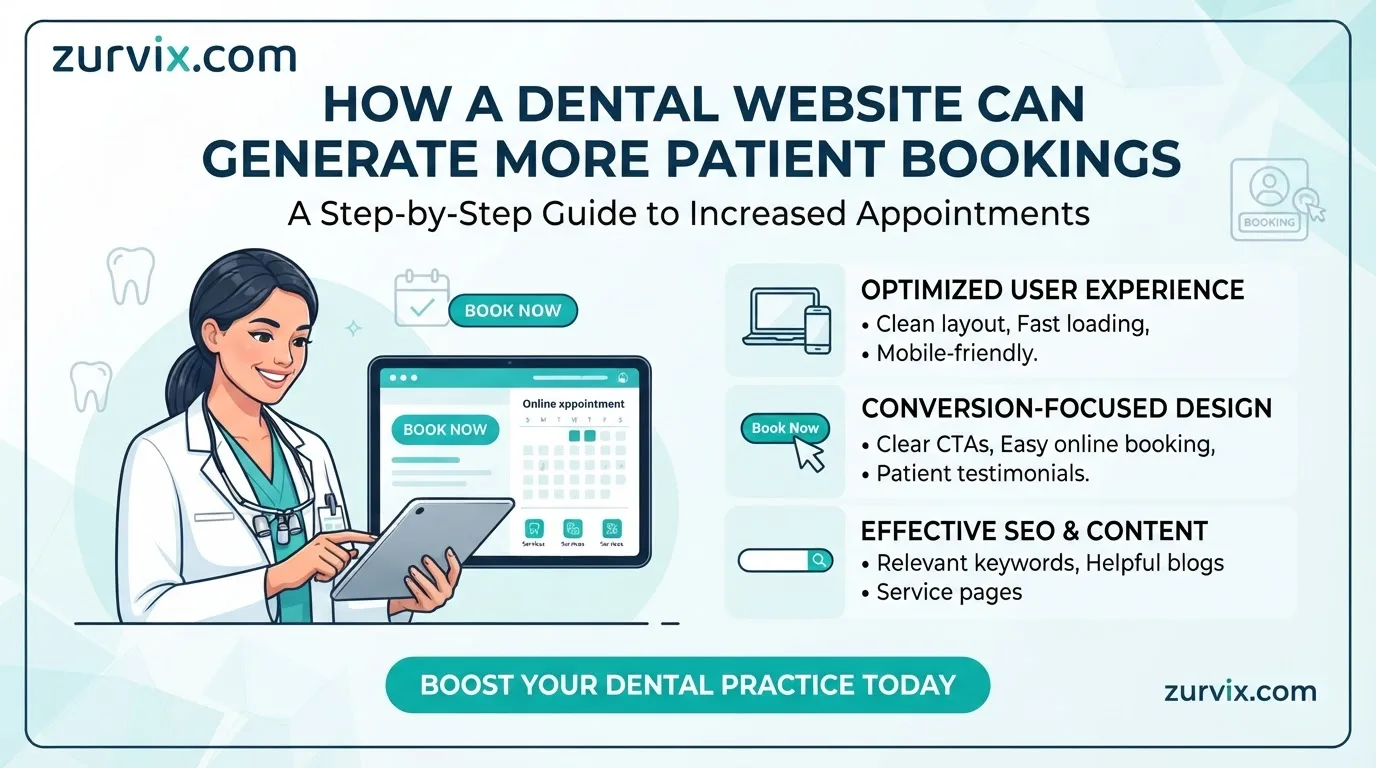
How a Dental Website Can Generate More Patient Bookings
Learn how dental websites can build patient trust, improve online booking and support SEO-driven patient acquisition.
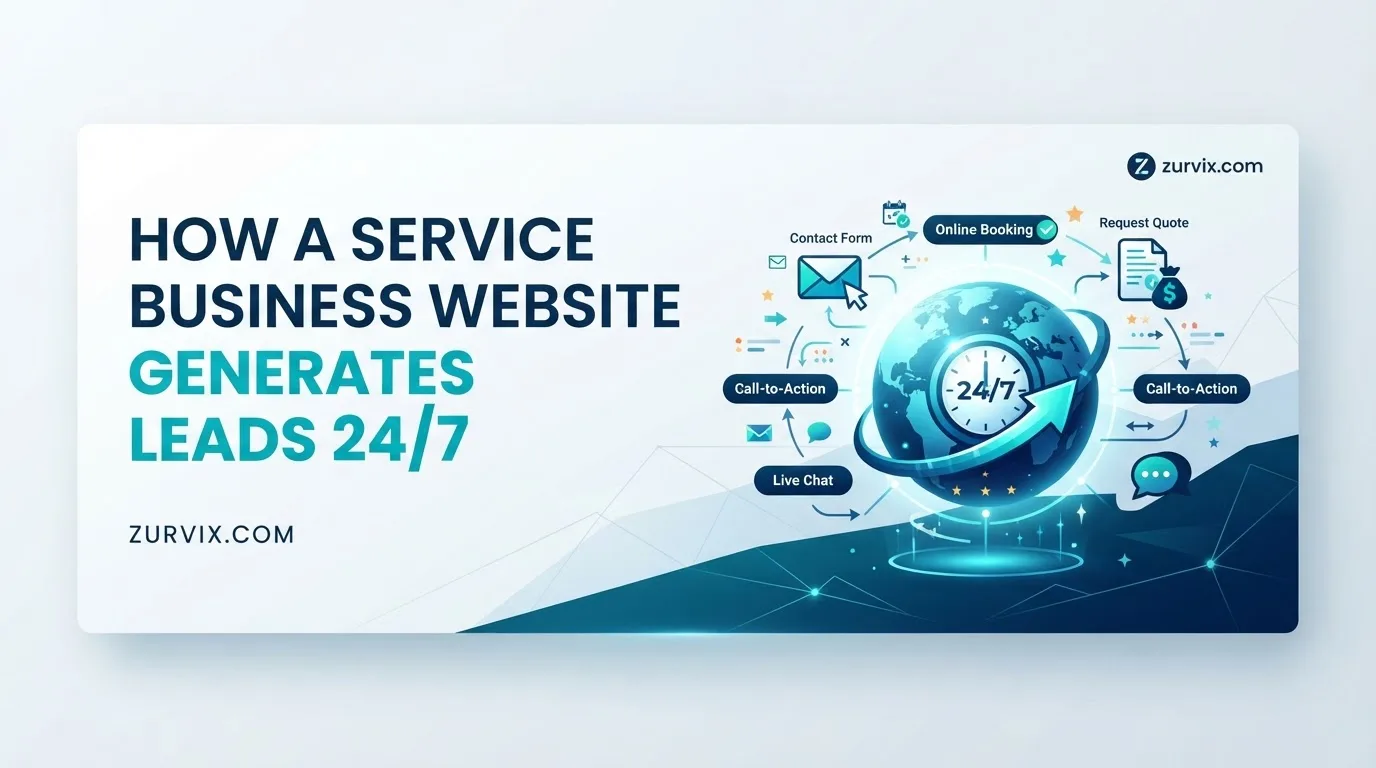
How a Service Business Website Generates Leads 24/7
Discover how service businesses can use websites, SEO and conversion-focused design to generate qualified leads around the clock.