
Template Website vs Custom Website: Which Should You Choose?
Compare template and custom websites by cost, speed, flexibility, SEO, performance, maintenance and long-term business growth so you can choose the right approach.
Founder & Principal Technologist
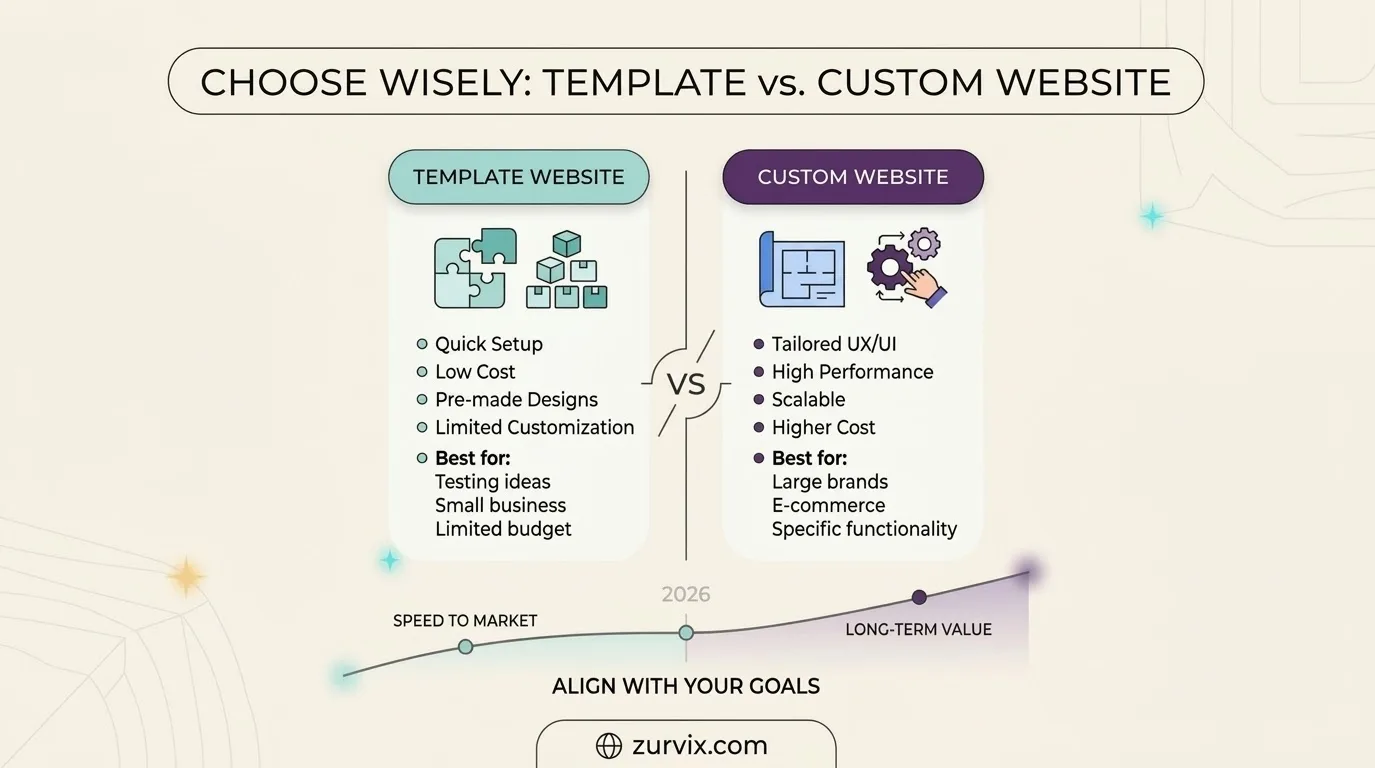
Choosing between a template website and a custom website is not simply a question of which one is cheaper. The better choice depends on what your business needs today, how quickly you need to launch, how unique the customer experience must be, and where you expect the business to be in the next few years.
A template can be an efficient solution for a straightforward website. Custom website development can make more sense when you need a distinctive brand experience, advanced functionality, integrations or a platform that can grow with the business.
This guide compares template vs custom websites in practical terms, including cost, speed, design flexibility, performance, SEO, maintenance, scalability and return on investment.
What Is a Template Website?
A template website starts with a pre-designed layout or theme. You customise elements such as colours, typography, images, content and sometimes page structure.
Templates are common in platforms and website builders because they reduce the amount of design and development work needed to launch a site.
A template can be a good choice when you need a simple online presence and your requirements closely match what the template already provides.
What Is a Custom Website?
A custom website is designed and developed around your business requirements rather than starting with a fixed visual layout.
The team can create the information architecture, user experience, design system, functionality and integrations around the actual customer journey.
Custom does not automatically mean better for every business. It means more control, which becomes valuable when your requirements cannot be handled efficiently by a template.
Template vs Custom Website: Quick Comparison
| Factor | Template Website | Custom Website |
|---|---|---|
| Initial cost | Usually lower | Usually higher |
| Launch speed | Often faster | Usually requires more planning and development |
| Design flexibility | Limited by the template/system | High |
| Unique functionality | Depends on available features/plugins | Can be built around requirements |
| Brand differentiation | Can be limited | Strong potential |
| Integrations | Depends on compatibility | Can be designed specifically for the required systems |
| Maintenance | Depends on platform, theme and plugins | Depends on the technology and development architecture |
| Scalability | Depends on platform limitations | Can be planned around future requirements |
When Is a Template Website the Better Choice?
A template can make sense when your main goal is to establish a professional online presence quickly without requiring unusual functionality.
It may be suitable for:
- Small business websites
- Simple service websites
- Personal or professional profiles
- Early-stage businesses testing an idea
- Simple portfolios
- Businesses with limited content and straightforward customer journeys
The important point is to choose a template that does not create unnecessary technical limitations for your actual business needs.
When Should You Choose a Custom Website?
Custom development becomes more attractive when the website is an important part of the business rather than simply an online brochure.
Consider custom development if you need:
- A unique customer journey
- Advanced booking or quotation workflows
- Custom dashboards or admin panels
- CRM, ERP, POS or third-party integrations
- Complex ecommerce functionality
- Membership or subscription systems
- Custom calculators or configurators
- Unique search or filtering experiences
- AI-powered features or automation
- A platform expected to grow significantly
Which Is Better for SEO?
Neither approach automatically wins SEO. A well-built template website can perform well, and a poorly developed custom website can perform badly.
Search performance depends on factors such as useful content, crawlability, site architecture, page experience, mobile usability, internal linking, technical implementation and the authority and relevance of the website.
Google's SEO Starter Guide provides a useful official overview of search fundamentals.
Whichever approach you choose, plan SEO into the website from the beginning rather than treating it as an afterthought.
Which Is Better for Website Speed?
A template website can be fast if it is lightweight and properly configured. It can also become slow when it relies on excessive plugins, scripts, large images or unnecessary features.
A custom website gives developers more control over the technology and performance architecture, but custom code does not guarantee speed. Poor development decisions can still create performance problems.
For either approach, measure real user experience and optimise images, scripts, server response and page structure. See our guide How Website Speed Affects Business Sales and Customer Experience.
Which Option Is Easier to Maintain?
Maintenance depends more on the platform and implementation than on the word “template” or “custom”.
A template website can require frequent theme/plugin updates. A custom website may require developer support for framework updates, deployments and technical changes.
For a business owner, the ideal setup is simple: everyday content should be manageable through an admin panel, while technical maintenance, backups, security and infrastructure should be properly managed.
Read Is a Website Easy to Maintain? What Business Owners Should Expect for a deeper explanation.
Template Website Cost vs Custom Website Cost
Template websites generally have a lower initial development cost because some design and functionality already exist. Custom projects usually cost more because the design, development, testing and integrations are created around the business.
But initial price is only one part of the decision. Consider the total cost of ownership:
- Development or setup
- Hosting and domain
- Premium themes or plugins
- Maintenance
- Third-party subscriptions
- Future feature development
- Redesign or migration costs
- Potential lost revenue from limitations or poor conversion
For another perspective, see How Much Does a Business Website Cost in 2026?.
Think About the Customer, Not Just the Technology
The most important question is not “Which technology should I use?” It is “What does my customer need to do?”
A restaurant customer may need to view a menu, check opening hours and book a table. A construction company visitor may want to see projects and request a quote. An ecommerce customer may need fast product discovery, filtering, checkout and delivery information.
Choose the technology that makes those journeys reliable and easy.
Template Website vs Custom Website for Different Businesses
| Business Type | Potentially Suitable Starting Point |
|---|---|
| Simple local service business | High-quality template or custom-lite website |
| Professional consultant | Template can work; custom may help with stronger branding |
| Restaurant | Template can work for simple needs; custom helps with advanced ordering/booking |
| Ecommerce | Platform/template for standard stores; custom for complex commerce requirements |
| Large organisation | Custom architecture often makes more sense |
| Marketplace or web application | Custom development is usually more appropriate |
Questions to Ask Before Choosing
- What does the customer need to accomplish on the website?
- Which features are essential at launch?
- Will the website need payments, bookings, CRM or other integrations?
- Who will update the content?
- How much design differentiation does the brand need?
- What traffic and business growth do you expect?
- What is the realistic total cost over three years?
- Who will provide security, backups and technical support?
- Can the solution be improved without rebuilding everything?
Common Mistakes to Avoid
- Choosing only by price: The cheapest initial option may not be the cheapest long term.
- Buying features nobody needs: More functionality does not automatically create more value.
- Ignoring content: Great technology cannot compensate for weak business information.
- Forgetting mobile users: The website should work well across relevant devices.
- Adding too many plugins: Unnecessary dependencies can increase maintenance and performance risks.
- Skipping analytics: You need measurement to understand whether the website is producing business results.
Frequently Asked Questions
Is a custom website better than a template website?
Not automatically. A custom website is better when your business needs greater control, unique functionality or a specific customer experience. A well-chosen template can be more practical for straightforward requirements.
Is a template website cheaper?
Usually the initial development cost is lower, but total cost depends on themes, plugins, subscriptions, maintenance, future changes and limitations.
Can a template website rank on Google?
Yes. Template websites can rank in search when they have useful content, sound technical SEO, good site structure, strong relevance and a positive user experience.
How long does it take to build a custom website?
It depends on the number of pages, design requirements, functionality, integrations, content and testing. A simple custom site can be relatively quick, while a complex web application can take substantially longer.
Can I start with a template and move to custom later?
Yes, but migration can involve redesign, content migration, URL changes, SEO preservation and data/integration work. If significant growth is already expected, it can be worth planning the architecture early.
Which is better for ecommerce: template or custom?
For standard ecommerce requirements, an established ecommerce platform can be highly effective. Custom development becomes more valuable when you need unusual product logic, integrations, workflows or customer experiences that standard tools cannot handle efficiently.
Does custom development improve website speed?
Custom development can provide greater performance control, but it does not guarantee a faster website. Speed depends on implementation, hosting, assets, scripts, architecture and ongoing optimisation.
How do I decide which website is right for my business?
Start with business goals and customer journeys, then list essential features, budget, timeline, integrations, maintenance needs and expected growth. Choose the simplest technology that can reliably support those requirements.
Final Takeaway
The best website is not necessarily the most expensive or the most technically complex. It is the one that gives your customers a good experience and gives your business the functionality, control and growth capacity it actually needs.
Choose a template when simplicity and speed are the priorities. Choose custom development when flexibility, differentiation and complex business requirements justify the additional investment.
Want help choosing the right approach? Explore ZURVIX website design and development services.
Found this useful? Share it with founders and engineering leaders.
Ready to implement these technical standards in your business?
Connect directly with our senior engineering and growth team on WhatsApp for an immediate consultation and bespoke digital roadmap.
Related Reading & Insights:
View all →
How a Dental Website Can Generate More Patient Bookings
Learn how dental websites can build patient trust, improve online booking and support SEO-driven patient acquisition.
How a Service Business Website Generates Leads 24/7
Discover how service businesses can use websites, SEO and conversion-focused design to generate qualified leads around the clock.