
How Much Does a Business Website Cost in 2026?
How much does a business website cost in 2026? This practical guide breaks down DIY, freelancer, agency and custom website pricing, plus domains, hosting, maintenance, SEO, ecommerce, AI features, hidden costs and ROI—so you can choose the right website investment for your business.
Founder & Principal Technologist

So, how much does a business website actually cost in 2026? The honest answer is: it depends. A simple website can be built for a relatively small budget, while a custom ecommerce store, booking platform or web application can cost many times more.
But price alone is a poor way to compare websites. Two websites can both have ten pages and have completely different costs because one uses a template while the other includes custom UX, copywriting, SEO, integrations, automation, analytics and ongoing support.
This guide breaks down what you are really paying for, what website pricing looks like in 2026, which costs are one-time versus recurring, where businesses often overspend, and how to judge whether a website is actually a good investment.
The Short Answer: Website Cost in 2026
Current 2026 market guides show a very wide range. DIY website builders can cost tens of euros per month, freelancer projects commonly range from hundreds to several thousand euros, and custom agency projects can reach five figures or more. Shopify's 2026 website cost guide also shows how widely pricing varies by platform, design, functionality and ongoing requirements.
For a business owner, a more useful way to think about the market is:
- DIY / website builder: lower cash cost, but you invest your own time and accept platform limitations.
- Freelancer: often a good fit for straightforward business websites with a defined scope.
- Professional studio or agency: higher investment, usually with more strategy, UX, custom development, content, integrations and support.
- Custom platform: appropriate when the business needs unique workflows, portals, marketplaces, complex ecommerce or application-style functionality.
There is no universal “correct” price. The right budget depends on what the website needs to accomplish.
Why Website Prices Are So Different
Think about buying a car. Asking only “How much does a car cost?” does not tell you much. A small city car and a professional delivery van solve different problems.
Websites are similar. A five-page company website and a multi-vendor ecommerce platform are both called “websites”, but they are very different products.
The biggest pricing factors include page complexity, custom versus template design, UX research, copywriting, photography, CMS requirements, ecommerce, booking systems, payments, CRM integrations, customer accounts, AI automation, SEO, multilingual functionality, hosting, security, backups and maintenance.
1. DIY Website: Cheapest in Money, Not Always in Time
Website builders can make it possible for a business owner to create a website without hiring a developer. This can be reasonable for a new business testing an idea or a very small operation with limited requirements.
The trade-off is your time. You may spend evenings adjusting layouts, writing copy, fixing mobile spacing, connecting forms and learning SEO settings.
DIY is not “bad”. It is simply a different cost model: less money spent on professional services, more time and responsibility retained by the business owner.
2. Freelancer Website: A Middle Ground
A freelancer can be a strong choice when you know what you need and the project is relatively contained. A typical project may include an adapted or custom design, responsive development, CMS functionality, forms and basic SEO setup.
Compare the scope rather than just the headline price. Ask what is included in design, development, content, revisions, hosting, maintenance and post-launch support.
3. Agency or Studio Website
An agency or professional studio may bring strategy, UX, custom design, development, SEO foundations, analytics, integrations, quality assurance and launch support into the project. That additional work is one reason agency pricing can be significantly higher than a basic template build.
4. Ecommerce Website Costs More Because It Does More
An ecommerce website is not simply a normal website with a “Buy” button. It may need product catalogues, categories, filters, search, variants, inventory, customer accounts, carts, checkout, payments, shipping, tax rules, order management, returns and analytics.
Payment processing is also an operating cost. For example, Stripe's current pricing varies by market, card type and payment method, with additional charges possible for international cards and currency conversion. Stripe pricing.
For a deeper ecommerce discussion, read How to Build an E-commerce Website That Converts Visitors Into Customers and Why Every E-commerce Business Needs Its Own Website.
5. Custom Web Applications Are a Different Category
If your “website” needs customer dashboards, staff dashboards, marketplace functionality, subscriptions, complex APIs, inventory systems, CRM workflows or business-specific automation, you are moving toward a web application. At this level, pricing should be based on workflows and technical requirements, not simply page count.
Website Cost Breakdown: What Are You Actually Paying For?
Domain
Your domain is the address customers use to find you. Pricing varies by extension and registrar. Premium domains can cost much more than standard registrations.
Hosting
Hosting stores and serves your website. A simple brochure website may need modest resources, while ecommerce, high-traffic sites and applications may require stronger infrastructure.
Design
Professional design considers hierarchy, typography, accessibility, mobile behaviour, brand consistency and the customer's path toward an action.
Development
Development turns the design into a functioning website. Costs increase with custom functionality, integrations, APIs, dashboards, automation and unusual workflows.
Content
Website copy is often underestimated. Good content requires research, positioning, editing and an understanding of what customers actually want to know.
SEO
SEO can include technical setup, information architecture, keyword and search-intent research, content, internal linking, structured data, image optimization, local SEO and ongoing measurement.
Maintenance
Websites need updates, backups, security monitoring, bug fixes and content changes. A website that is never maintained can become a liability.
One-Time Costs vs Recurring Costs
One-time or project costs may include strategy, UX/UI design, development, migration, initial content and launch configuration.
Recurring costs may include domain renewal, hosting, maintenance, premium software, email services, payment processing, SEO, content production, advertising and support.
Do not compare a €500 project with a €50/month platform as though they are identical. One is a project price; the other may be a continuing subscription.
Hidden Website Costs Businesses Forget
- Professional copywriting
- Photography and video
- Logo or brand work
- Premium fonts or plugins
- Booking software
- CRM software
- Email marketing tools
- Payment processing
- Multilingual translation
- Ongoing SEO
- Content updates
- Security and backups
- Technical maintenance
- Redesigns and future feature development
These are not necessarily bad surprises. They are part of the total cost of owning a digital business asset.
What Does a €300 Website Look Like?
A low-cost website can be perfectly suitable when the scope is genuinely small. A simple service website may need a homepage, a few service sections, contact information, responsive design and basic hosting.
The problem starts when a business expects a €300 project to include custom UX research, professional copywriting, advanced SEO, ecommerce, CRM integration, AI automation, multilingual content and unlimited revisions.
Low price is not the problem. Unrealistic scope is.
What Does a €1,000–€3,000 Website Give You?
Depending on the provider and market, this range can support a more polished small-business website with stronger design, better content structure, responsive development, CMS functionality and more attention to SEO and conversion.
Actual market pricing varies widely by country and provider. Current 2026 guides illustrate that spread. Shopify's current pricing overview and a 2026 small-business website cost analysis provide useful comparison points.
What About €3,000–€10,000+?
At this level, you may be paying for significantly more customization, strategy and functionality: custom UX, conversion-focused landing pages, advanced ecommerce, CRM integration, booking workflows, custom tools, customer portals, automation, advanced analytics or multilingual websites.
For larger organizations, budgets can go far beyond this when the website becomes a major digital platform.
How Much Should a Small Business Spend?
There is no universal percentage of revenue every business should spend on its website. Work backwards from the business goal.
If you need ten qualified leads per month, ask what the average customer is worth. If you sell products online, estimate margin and sales volume. If you mainly need credibility, your requirements may be very different from an ecommerce company.
Build the smallest system that can realistically achieve the goal, then improve it as the business grows.
How to Calculate Website ROI
For a service business, a simplified model is qualified leads × average customer value × close rate. For ecommerce, consider transactions × average order value × contribution margin.
These are simplified models, but they are more useful than asking whether the website “looks professional”. For more detail, read How to Calculate the ROI of a Business Website.
Don't Forget Conversion Rate
Suppose two websites each receive 1,000 relevant visitors per month. If Website A generates 10 enquiries and Website B generates 40, traffic alone does not tell the whole story.
Conversion depends on the offer, trust, page structure, speed, mobile UX, forms, calls to action, pricing clarity and how closely the page matches search intent. Sometimes the better investment is making existing traffic more valuable.
AI Website Builders in 2026: Can They Make Websites Cheaper?
AI-assisted website builders and coding tools can generate layouts, code, content drafts and prototypes much faster. But faster production does not automatically mean a better business website.
You still need strategy, customer research, conversion planning, maintainable code, accessibility, performance and genuinely useful content.
AI can reduce production time. It does not remove the need for strategy.
Does SEO Increase Website Cost?
It can, especially when SEO is treated as an ongoing growth activity rather than a checkbox. Good SEO may involve technical audits, keyword research, search-intent mapping, content creation, internal links, structured data, image optimization, local SEO, digital PR and measurement.
The important distinction is between SEO foundations and ongoing SEO growth. A new website should have a solid technical and content foundation, while competitive markets may require continuous work.
What About GEO and AI Search?
GEO is commonly used for Generative Engine Optimization—the practice of improving how useful and understandable your content is for generative search experiences.
There is no reliable “AI ranking trick” that guarantees a business will be recommended by every AI system. Publish original information, answer real customer questions, explain services clearly, demonstrate expertise, keep business facts consistent and make the site technically accessible.
Google's current Search guidance says existing SEO fundamentals continue to matter for generative AI search experiences. Google Search Central updates.
Website Performance Is Part of the Investment
A beautiful website that feels slow can waste the money spent on design and marketing. Performance work can include image optimization, caching, code optimization, hosting improvements, CDN configuration and reducing unnecessary third-party scripts.
See web.dev's Core Web Vitals guidance and Cloudflare's website performance troubleshooting guide.
International and European Websites Can Cost More
If you sell across Europe or internationally, requirements may include multiple languages, currencies, regional payment methods, shipping rules, tax considerations, localized content and international SEO. Localization should help a real audience in that market rather than simply repeating country names.
What Should Be Included in a Website Quote?
- Number and type of pages
- Design and revision process
- Content responsibilities
- Responsive/mobile development
- CMS access
- Domain and hosting ownership
- SSL and security
- Forms and integrations
- SEO foundations
- Analytics setup
- Launch support
- Bug-fix period
- Maintenance terms
- Future feature costs
A transparent proposal is usually more valuable than the cheapest proposal.
How to Avoid Paying for Things You Don't Need
Start with the customer journey. How will customers find you? What do they need to understand? What objections will they have? What action do you want them to take?
Then prioritize features that directly support those answers. You probably do not need ten complicated animations if customers cannot find your services. You probably do not need an AI chatbot if your contact information is confusing. And you probably should not spend heavily on a custom dashboard before validating that customers actually need it.
Website Cost vs Website Value
Do not ask only, “How much will the website cost?” Also ask how many customers it could help acquire, how much time it could save, whether it could increase booking or checkout completion, whether it could support international growth and whether it could become an asset that grows in search over time.
ZURVIX Website Packages
ZURVIX approaches website projects around the business requirement rather than forcing every company into the same package.
- Business/service websites: from €300, including domain and hosting.
- Ecommerce websites: from €500, including domain/hosting, smart admin panel and customization.
- Custom websites: from €350, with customization, domain/hosting, AI features and an easy admin panel.
- Website and app projects: available when the business needs a mobile product alongside its web platform.
These are starting prices, not universal quotes. Final pricing depends on scope, functionality, content, integrations and customization.
Compare this guide with Why Every Business Needs a Website in 2026 and Website vs Facebook Page: What Does a Business Really Need?.
Frequently Asked Questions
How much does a business website cost in 2026?
There is no single price. DIY platforms can be relatively inexpensive, freelancers may charge hundreds to several thousand euros, and professional agency or custom projects can cost several thousand euros or much more. The right price depends on scope and requirements.
What is the cheapest way to build a business website?
A DIY website builder is usually the lowest-cash-cost route. Include your own time, platform fees and future limitations when comparing the true cost.
Is €300 enough for a business website?
It can be enough for a tightly scoped basic business website, especially when design, content and functionality requirements are simple. It is unlikely to cover a large custom platform with advanced integrations.
How much does ecommerce website development cost?
Ecommerce costs vary because stores require product management, checkout, payments, orders and often shipping, tax, customer accounts and marketing integrations. Define customer and admin workflows before choosing a price.
What are the ongoing costs after a website is launched?
Common recurring costs include domain renewal, hosting, maintenance, security, backups, premium software, payment processing, content, SEO and marketing. Not every business needs every item.
Should I choose a template or custom website?
Choose a template when requirements are simple and speed or budget is the priority. Choose custom development when your brand, customer journey, integrations or workflows need something more specific.
Is a cheap website a bad investment?
Not necessarily. A simple website can be excellent value if it solves a simple problem well. The problem is paying for features you do not need or choosing a cheap build that cannot support the business goal.
Does a more expensive website rank higher on Google?
No. Website price is not a Google ranking factor. Search performance depends on relevance, content quality, technical accessibility, competition, authority and user experience.
Do I need monthly SEO after my website launches?
Not every business needs the same level of ongoing SEO. A new website should have sound technical foundations, but competitive markets may benefit from continuous content, authority building, technical improvements and conversion optimization.
How long should a business website last?
There is no fixed lifespan. A well-maintained website can remain useful for years, but design, technology, security, content and customer expectations change. Review it regularly rather than waiting for it to become outdated.
Final Takeaway
The best website budget is not the biggest one. It is the budget that matches the business goal.
A local service business may need a focused lead-generation website. An ecommerce brand may need a high-converting store. A growing company may need CRM automation. A marketplace or technology business may need a custom application.
Start with the customer, define the outcome, build the essential functionality and measure what happens after launch. That is how a website changes from an expense into a business asset.
Need help deciding what your business actually needs? ZURVIX provides website and app design, development, digital marketing, SEO/GEO and website maintenance for businesses that want a practical digital system—not just a pretty homepage.
Found this useful? Share it with founders and engineering leaders.
Ready to implement these technical standards in your business?
Connect directly with our senior engineering and growth team on WhatsApp for an immediate consultation and bespoke digital roadmap.
Related Reading & Insights:
View all →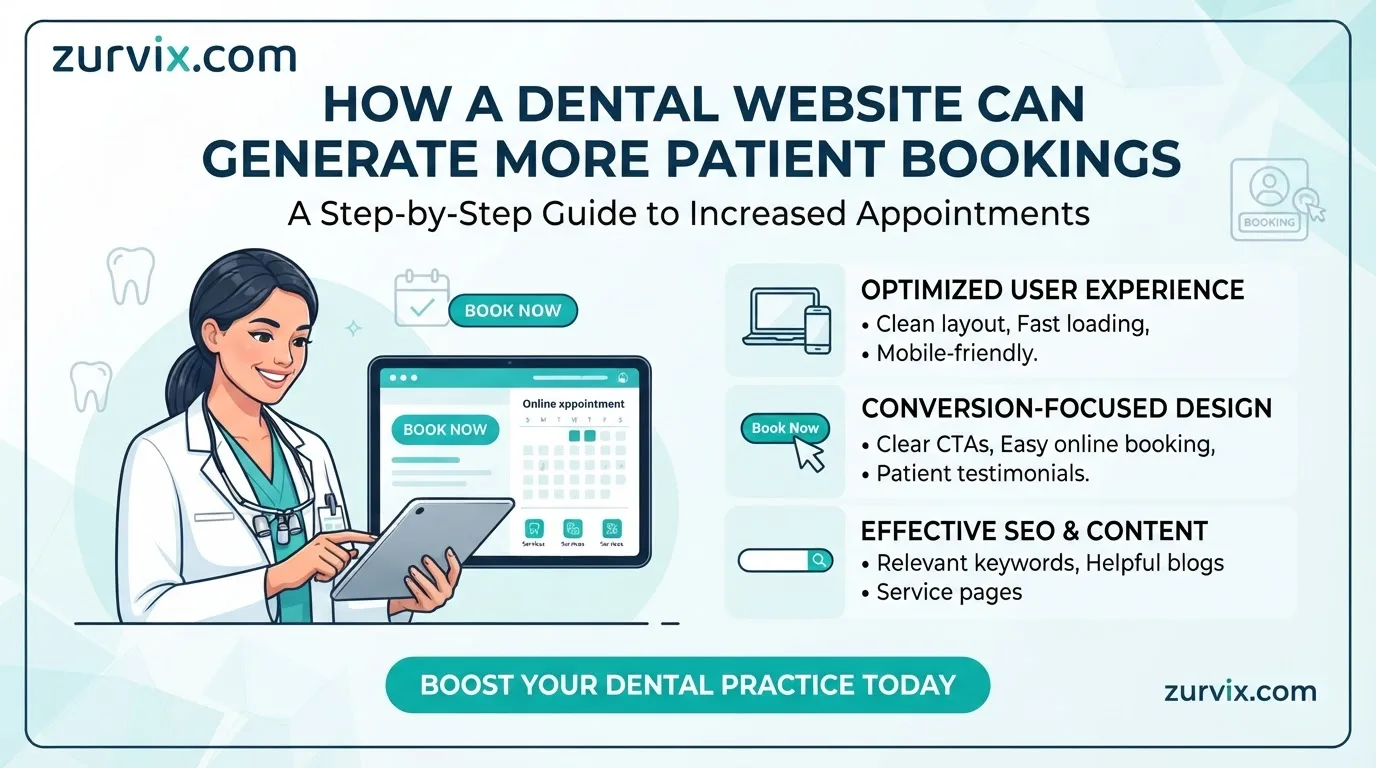
How a Dental Website Can Generate More Patient Bookings
Learn how dental websites can build patient trust, improve online booking and support SEO-driven patient acquisition.
How a Service Business Website Generates Leads 24/7
Discover how service businesses can use websites, SEO and conversion-focused design to generate qualified leads around the clock.