
Why Retail & Local Shops Need a Website Beyond Social Media
Instagram and Facebook can help local shops get attention, but a website gives retailers a searchable, owned digital home for products, information, trust and customer conversions.
Founder & Principal Technologist
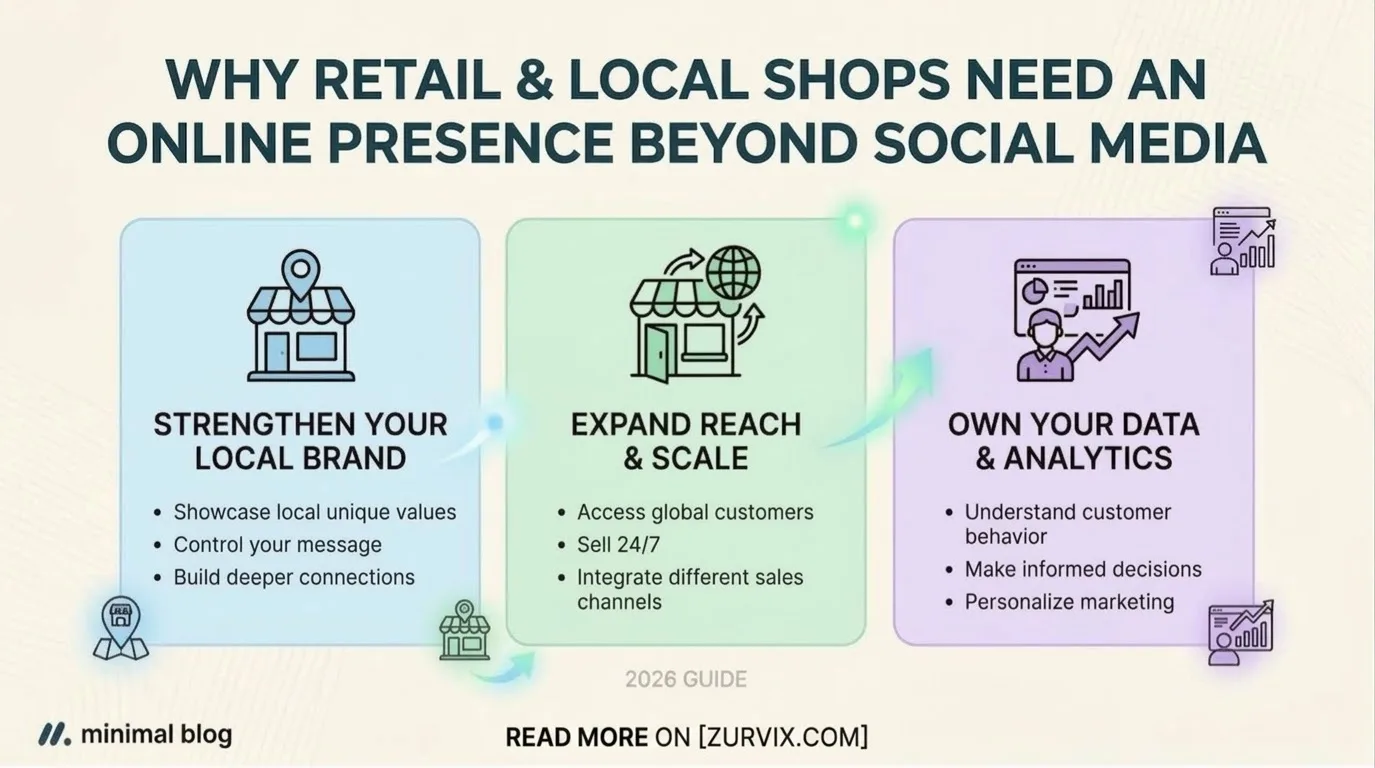
Social media is useful for a retail business, but it should not be your entire online presence. Instagram and Facebook can help a shop showcase products, build a community and reach existing followers. A website gives the business something different: an owned digital home that customers can find through search, use to research products and services, and return to whenever they need information.
For a local shop, the question is not really “website or social media?” A stronger strategy is usually website + social media + local search.
In this guide, we explain why retail and local shops need an online presence beyond social media, how a website supports Google discovery, what information it should contain, how it can help generate sales and enquiries, and how to connect the website with social channels.
Why Social Media Alone Is Risky for a Retail Business
Social platforms are powerful distribution channels, but the business does not control the platform, its algorithms or the way content is presented to every potential customer.
A social profile also tends to organise information around a feed. A customer who wants to find your opening hours, product categories, delivery information, return policy or a specific service may have to search through posts or send a message.
A website lets you organise important business information into permanent pages that customers and search engines can access.
What a Website Can Do That a Social Profile Cannot Do as Well
- Capture Google search demand: Customers can discover dedicated pages when searching for products, services or local businesses.
- Organise your information: Products, services, opening hours, locations, FAQs and contact details can have clear dedicated sections.
- Support direct conversions: Customers can request a quote, book, contact you or purchase online.
- Build long-term search visibility: Useful website content can continue attracting relevant visitors after a social post has moved down the feed.
- Strengthen trust: Your website can present your story, policies, reviews, projects, guarantees and contact information in one place.
- Connect marketing channels: Social, search, email and advertising traffic can all lead to relevant website pages.
Google Search and Local Discovery
People often search before visiting a shop. They may search for a product, compare options, check opening hours or look for a nearby business.
For local businesses, a complete Google Business Profile is an important part of local discovery. Google explains that businesses can manage how their information appears across Google Search and Maps through Business Profile.
See Google's official Google Business Profile guidance for more information.
Your website can support that presence by providing detailed, accurate information that customers can use after discovering the business in search or Maps.
Website + Google Business Profile + Social Media
Think of the three channels as having different jobs:
| Channel | Main Role |
|---|---|
| Website | Owned information, SEO, product/service discovery and conversion |
| Google Business Profile | Local discovery, Maps visibility and essential business information |
| Social media | Awareness, engagement, community and product/content promotion |
This approach reduces dependence on any single platform and gives customers multiple ways to discover the business.
What Should a Local Shop Website Include?
A small retail website does not need hundreds of pages. It needs the right information, presented clearly.
Depending on the business, useful sections can include:
- Homepage with a clear value proposition
- Product or service categories
- Featured products or offers
- About the business
- Opening hours
- Location and directions
- Contact details
- Delivery or collection information
- Returns and important policies
- Customer reviews or testimonials
- Frequently asked questions
- Blog or buying guides
If you sell online, the website can also include product pages, search, filters, cart and checkout.
Do Local Shops Need a Full Ecommerce Website?
Not necessarily. This is an important distinction.
A local shop can benefit from a website even if customers cannot purchase online. A simple site can help people discover the shop, view products or services, check opening hours, find the location and contact the business.
Ecommerce becomes more useful when customers frequently want to browse, compare and purchase remotely, or when the business wants to expand beyond its physical location.
For businesses considering ecommerce, see How to Build an E-commerce Website That Converts Visitors Into Customers.
How a Website Can Turn Searchers Into Store Visitors
Imagine someone searches for “running shoes near me”. They find a local business profile, visit the website and see the relevant product category, opening hours, location and contact details.
That website visit can answer the questions standing between “I found this shop” and “I will visit this shop.”
The same principle works for furniture stores, electronics shops, fashion retailers, pharmacies, home improvement businesses, speciality stores and many other retail categories.
How a Website Can Support Online Sales
If you sell online, your website becomes more than an information page. It becomes part of the sales infrastructure.
A conversion-focused ecommerce website should make it easy to:
- Find products
- Compare options
- Understand pricing
- See availability where relevant
- Understand delivery and returns
- Add products to a cart
- Complete checkout securely
- Contact support when needed
Average order value can also be increased with relevant recommendations, bundles, cross-sells and appropriate free-shipping thresholds. See How an E-commerce Website Can Increase Average Order Value.
Why Website Content Matters for Retail SEO
One of the biggest advantages of having a website is the ability to create pages around the questions and searches your customers actually have.
Instead of publishing only “New Product!” posts, a retailer could create useful pages such as:
- How to choose the right product
- Product comparisons
- Buying guides
- Frequently asked questions
- Care and maintenance guides
- Size or compatibility guides
- Local service information
Google's people-first content guidance is a useful reference when planning helpful website content.
How a Website Builds Trust Before a Customer Visits
Customers often want reassurance before choosing a business, especially when several retailers offer similar products.
Your website can communicate:
- How long the business has operated
- What brands or products you specialise in
- Customer reviews
- Clear contact details
- Physical location
- Delivery and returns information
- Warranty information where applicable
- Real photographs
- Professional policies and support information
For a broader look at website trust, read How a Professional Website Builds Customer Trust.
Website vs Social Media: Which Should You Prioritise?
| Need | Website | Social Media |
|---|---|---|
| Google search visibility | Strong role | Limited/direct role varies |
| Permanent business information | Excellent | Less structured |
| Product catalogue | Excellent | Useful but platform-dependent |
| Community engagement | Limited | Strong |
| Direct ecommerce | Strong control | Depends on platform/features |
| SEO content | Strong | Not a replacement for a website |
| Brand control | High | Platform-dependent |
The best answer for most growing retailers is not to choose one. Use social media to attract attention and the website to provide depth, search visibility and conversion.
How Much Does a Retail Website Cost?
The cost depends on whether you need a simple informational website, a product catalogue or a full ecommerce system.
Important cost factors include:
- Number of pages and products
- Custom design requirements
- Ecommerce and payment functionality
- Inventory or POS integrations
- Delivery and shipping requirements
- Content creation
- SEO requirements
- Hosting, domain and maintenance
For a wider 2026 pricing guide, read How Much Does a Business Website Cost in 2026?.
How to Measure Whether Your Website Is Helping the Shop
Do not judge the website only by how attractive it looks. Measure business outcomes.
Useful metrics include:
- Organic search visits
- Google Business Profile actions
- Calls and contact requests
- Directions or location interactions
- Product page views
- Online purchases
- Conversion rate
- Revenue from ecommerce
- Returning visitors
Analytics can help you understand how visitors interact with the site. Google's Google Analytics documentation provides official guidance on measurement.
Common Mistakes Retail Businesses Should Avoid
- Only linking to Instagram: Give customers a proper website destination.
- No product or service information: Visitors need enough detail to make decisions.
- Missing opening hours: Make essential local information easy to find.
- Outdated information: Incorrect prices, hours or product availability can damage trust.
- Ignoring mobile design: Your website should be easy to use on smartphones.
- No clear CTA: Tell customers whether to visit, call, book, enquire or buy.
- No measurement: Connect website activity with meaningful business outcomes.
Frequently Asked Questions
Does a local shop really need a website if it has Facebook and Instagram?
For a growing shop, a website can add significant value because it provides an owned place for detailed information, search visibility, product discovery and conversions. Social media is still useful, but it works best as part of a wider digital strategy.
Can a retail shop get customers from Google without an ecommerce website?
Yes. A website can help people discover your business, understand your products or services, find your location and contact you even if you do not sell online.
Should a local shop have a Google Business Profile?
Yes, if the business is eligible and serves customers at a physical location or within a service area. Keeping business information accurate is important for local discovery.
Is social media better than a website for retail marketing?
They serve different purposes. Social media is strong for awareness and engagement, while a website provides greater control over information, search visibility and conversion experiences.
Do small retail businesses need ecommerce?
No. Ecommerce is useful when online purchasing supports the business model. A simple local website can still generate value through discovery, trust, enquiries, directions and store visits.
How can a retail website improve local SEO?
Use accurate business information, relevant local content, clear service or product pages, good technical SEO, useful internal links and consistent business details. Connect the website with a well-maintained Google Business Profile.
How much does a retail website cost?
There is no single price. A simple informational site costs less than a full ecommerce platform with payments, inventory, shipping and integrations. Compare the required functionality and total running cost rather than choosing only by the lowest initial quote.
Can ZURVIX build a website for a retail or local shop?
Yes. ZURVIX can design and develop business and ecommerce websites, with options for custom functionality, SEO/GEO, analytics and ongoing maintenance.
Final Takeaway
Social media can help a local shop get attention, but it should not be the only place customers can find information about the business.
A website gives your shop an owned, searchable and structured digital presence. Combine it with Google Business Profile and social media, then measure which channels produce visits, enquiries and sales.
The goal is not simply to “have a website”. The goal is to make it easier for customers to find you, trust you and choose you.
Ready to build a stronger online presence for your retail business? Explore ZURVIX website and ecommerce development services.
Found this useful? Share it with founders and engineering leaders.
Ready to implement these technical standards in your business?
Connect directly with our senior engineering and growth team on WhatsApp for an immediate consultation and bespoke digital roadmap.
Related Reading & Insights:
View all →
How a Dental Website Can Generate More Patient Bookings
Learn how dental websites can build patient trust, improve online booking and support SEO-driven patient acquisition.
How a Service Business Website Generates Leads 24/7
Discover how service businesses can use websites, SEO and conversion-focused design to generate qualified leads around the clock.